
Innovative Product for Sustainability
New Product Development Workflow
Objectives
- To serve as a guideline for studying and developing new products with clear work procedures aligned with the company's goals and customer needs.
- To ensure that the new product development process incorporates environmental, health, safety, and product stewardship considerations throughout the product life cycle, while evaluating and managing relevant risks, including financial, regulatory, operational, environmental, and market-related risks, to support informed decision-making and sustainable business growth.
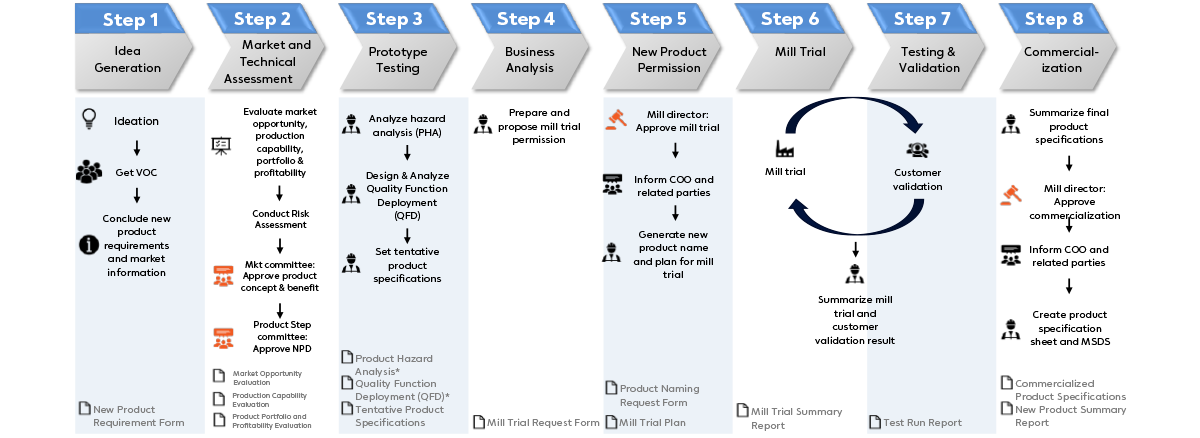
New Product Development Process, the environmental impact is considered throughout the development process as follows:
Step 1: Idea Generation
Collect information on customer needs regarding quality, safety, and environmental friendliness, aligned with the company’s policy.
Step 3: Prototype Testing
Consider designing products to be environmentally friendly, easy to dispose of , and reusable. Perform a Life Cycle Assessment (LCA) to quantitatively analyze and assess the environmental impact of the new product. This evaluation includes the use of resources, energy consumption, and waste emissions from raw material extraction to product creation (Cradle to Gate).
Step 6: Mill Trial
Plan the procurement of raw materials (Raw Materials & Production Supply Plan) as part of the mill trial process by selecting sustainable materials such as recycled materials and sustainable sources of wood/fiber.
Step 8: Commercialization
Review the Life Cycle Assessment (LCA) to ensure that the product launched in the market is environmentally friendly.
FYBROZEAL
FybroZealTM new solution for flexible packaging. FybroZeal™ is made from pure paper that, with specially developed coating chemical, can be ‘heat-sealed’ like plastic film. Being made purely from paper it is thus fully recyclable and biodegradable, and hence a very good environmentally friendly alternative for consumers. This type of packaging is often used for products or foods that does not easily spoiled or not require good protection from moisture or oxygen or to be kept for extended period. Or it can be used as outer secondary packaging together with inner primary packaging made from laminated film to enhance the barrier and hence longer shelf life.
OPTIBREATH
The 'OptiBreathTM ' packaging extends shelf of fresh fruits and vegetables by finely adjusting and controlling oxygen and carbon dioxide flow throughout the package with minimum respiration. Each fresh produce will be fresh and tasty inside the 'OptiBreathTM '.
EZY STEAM
Ezy SteamTM is an example of a successful flexible packaging product line. It is appropriate for food that is best heated or reheated in a microwave oven. Ezy SteamTM enables end consumers to heat packaged food in the microwave oven without having to first cut open the packaging.
The benefits of this is twofold:
- It is hygienic as it prevents contamination during the heating process
- It prevents the food content inside the packaging from spilling out during the heating process.
EZYPEEL
EzyPeelTM novel lidding film, allows for easy opening of containers. EzyPeelTM products can be easily open without the risk of spill-over or leaving stringy traces of plastic to the lid.
MICRO FLUTE
Micro flute: SCG Packaging developed Micro Flute paper for small-sized packaging. It offers a smooth surface to cater to high quality printing and great strength to satisfy the demand of industries for various packaging solutions.
GREEN CARTON
Aiming to provide more efficient products while enhancing the environment, SCG Packaging has developed Green Carton which can reduce paper consumption and energy usage while maintaining the stacking and protection abilities. This technology has been approved to be environmentally friendly as labeled “SCG Eco Value”, the criteria of which is in accordance with the ISO 14021 standard, Environmental Labels and Declaration-Self-Declared Environmental Claims. Eco-friendly “G Technology” invented by our professional team, “Green Carton” has less paper weight at 25 grams per square meter, thus reducing carton weight by 4%. Additionally, we strive constantly to develop the sustainable technology for our better society.
Paper Exhibition Solutions
Sustainable exhibition solutions crafted from recycled paper for events, booths, retail environments, and brand communications. Offering end-to-end services from design and production to installation and post-use management, each setup is customizable to match your space and brand objectives. Deliver an outstanding, versatile event experience while driving your brand image toward a sustainable future.