
Double Materiality
SCGP annually assesses double materiality in accordance to the GRI Standard (GRI3: Material Topics 2021) by considering both the financial and non-financial impacts of sustainability issues on its business operations and stakeholders. Double materiality is a concept that recognizes the importance of assessing both the internal impacts of sustainability issues on a company's financial performance and the external impacts of the company's activities on the environment, society, and governance.
SCGP also considers the financial materiality of sustainability issues by evaluating their potential impacts on the company's financial performance, including risks and opportunities. This involves analyzing factors such as regulatory changes, market trends, resource availability, and customer preferences that may affect SCGP's financial performance.
Furthermore, SCGP assesses the impact materiality (non-financial materiality) of sustainability issues by evaluating their impacts on the environment, society, and governance. This includes analyzing the company's carbon footprint, water usage, waste management practices, labor conditions, human rights, community engagement, and ethical business practices.
Process of Materiality Assessment and Prioritization
- Analyze sustainability issues throughout the value chain, encompassing raw material procurement, production, transportation and distribution, as well as the use of products and services
- Assess the actual and potential impacts on the basis of financial materiality to SCGP, and impact materiality. The assessments are conducted by relevant committee and business units.
- Assess economic, environmental and social impacts with ESG Committee involved in the process of review and validation prior to presentation to the Board of Directors
- Disclose material issues transparently and comprehensively to stakeholders, and listen to their opinions for mutual understanding and SCGP’s partnerships with stakeholders. The material sustainability issues are also reviewed once a year
| Step 1: Collect data and identify material sustainability issues | |
|---|---|
Materiality Issues from external stakeholders
|
Materiality issues within SCGP management
|
| Step 2: Assess Impacts | Step 3: Review and Validate | Step 4: Communicate with stakeholders |
|---|---|---|
|
SCGP assesses the actual and potential impacts on the basis of financial materiality to SCGP, and impact materiality. The assessments are conducted by relevant committee and business units. |
Assess economic, environmental and social impacts as well as other issues within the Enterprise Risk Management (ERM) framework, taking into account financial impacts, environmental and social impacts. Then, prioritize sustainability issues with the ESG Committee involved in the process of review and validation prior to presentation of these issues before the Board of Directors. |
Disclose material issues transparently and comprehensively to stakeholders, and listen to their opinions for mutual understanding and SCGP’s partnerships with stakeholders. The material sustainability issues are also reviewed once a year. SCGP assessed 18 sustainability issues based on a Double Materiality approach, which considers both:
The assessment identified 5“high materiality” issues namely: Strategic Importance Materiality
Fundamental Materiality
|
Double Materiality Matrix
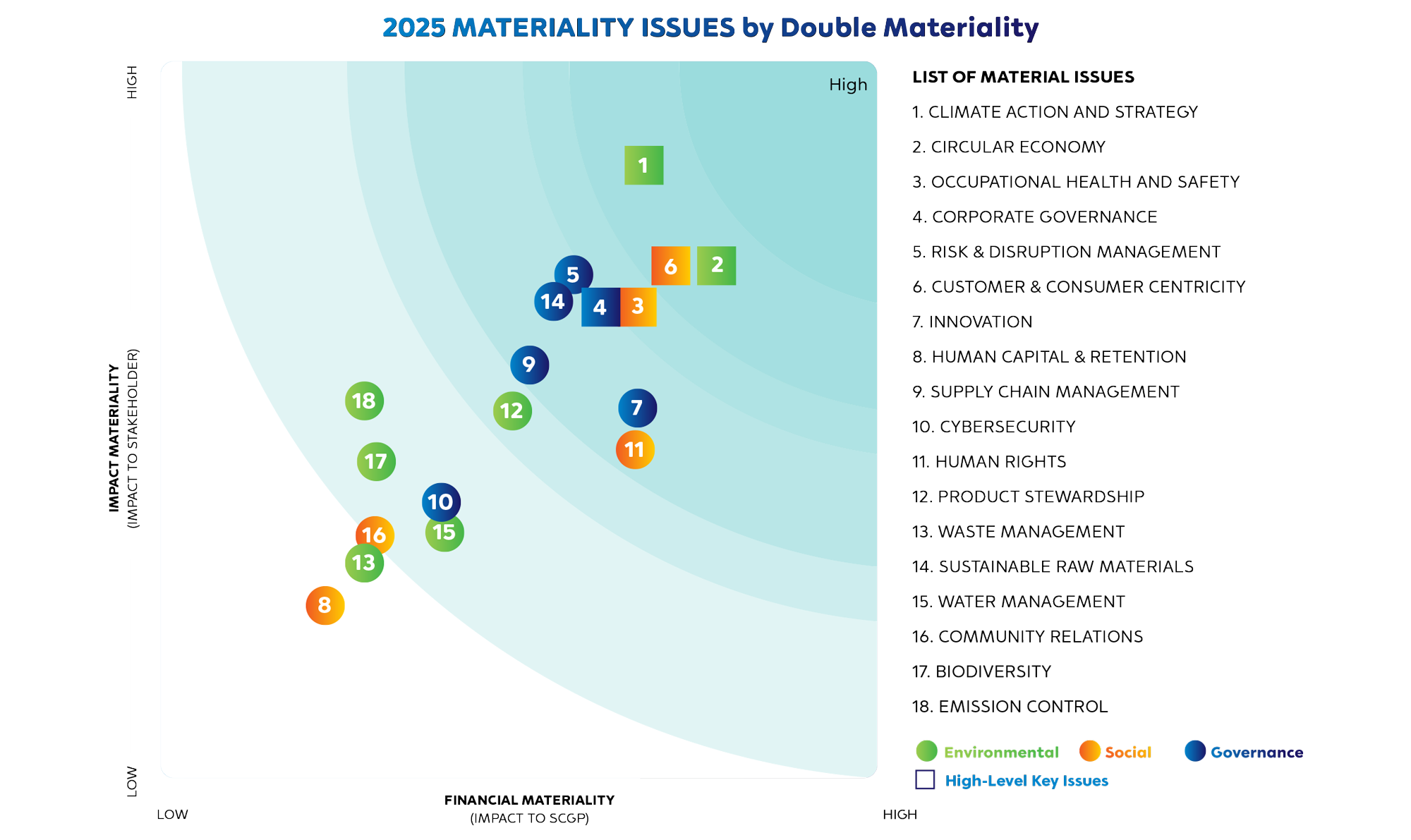
2025 Materiality Issues
Utilizing the Double Meateriality method, the review concluded that SCGP identified five material sustainability issues in 2025 which are as follows:
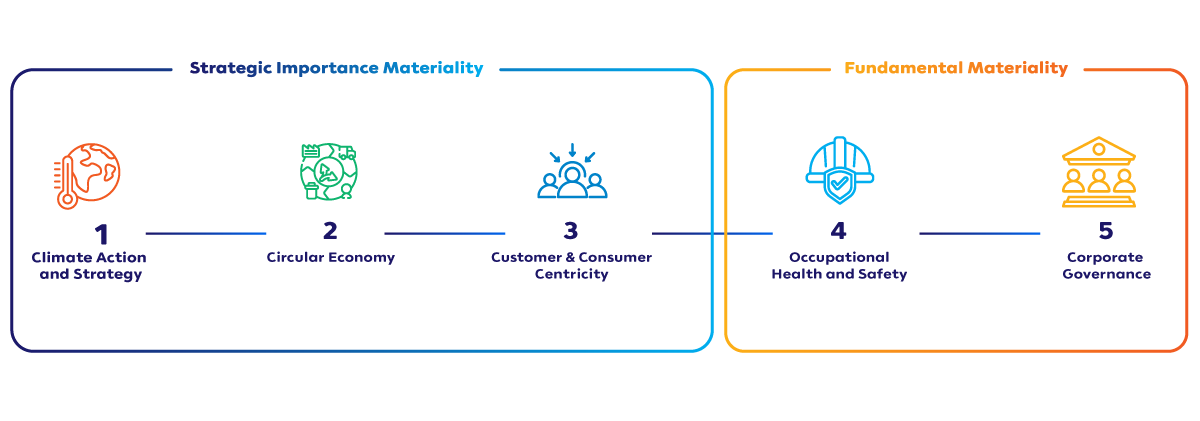
Following the review if SCGP’s Strategic importance materiality issues in 2025 through a Double Materiality assessment, three key issues were identified:
| Material Issues | Risks | Opportunities |
|---|---|---|
| 1. Climate Action and Strategy |
|
|
| 2. Circular Economy |
|
|
| 3. Customer and Consumer Centricity |
|
|
| 4. Occupational Health and Safety |
|
|
| 5. Corporate Governance |
|
|
Double Materiality Assessment 2025 (GRI 3-3)
Climate Action and Strategy
| Items | Impact on SCGP | Impact on Stakeholders | |
|---|---|---|---|
| Affected Stakeholders | Employees | Customers / Investors / Suppliers / Business partners / Environment / Society | |
| Cause of Impact | Operations | + Resilience to upcoming carbon related law and regulations - High investment for GHG reduction projects + Less Energy Cost |
- High GHG emissions affecting public health of local communities, ecosystems |
| Products/Services | + GHG Emission Reduction + Better reputation and customer confidence through ESG ratings and climate actions |
-High GHG product may lead to export ban or fee due to stringent carbon-related regulations. | |
| Supply Chain | + Reducing emissions is essential to maintain market access (e.g. Carbon Tax). | + Meet requirement/need of customers or investors focused on climate change | |
| Sectoral Damage | Health, Energy | ||
| Net Impact Valuation | > 1,000 million Baht |
| Opportunities |
|
| Main reference SDGs |
    |
| Management Strategies |
|
| Targets & Performance |
|
Circular Economy
| Items | Impact on SCGP | Impact on Stakeholders | |
|---|---|---|---|
| Affected Stakeholders | Employees | Customers / Investors / Government / Suppliers / Business partners / Environment / Society | |
| Cause of Impact | Operations | + Reduce costs in the production process and increase the efficiency of using resources due to 3Rs (Reduce/Reuse/Recycle). - Higher investment in management for difficult-to-recycle product groups, such as multilayer plastic packaging. |
|
| Products/Services | + Increase opportunities to sell sustainable packaging solutions with more recyclable, reusable and compostable packaging. + Increased sales revenue |
+ Customers have more eco product choices. + Circular economy initiatives lead to consumer preference for environmentally friendly products with awareness to minimize GHG emissions. - The price of the product has increased. |
|
| Supply Chain | + The government sector has received support for Extended Producer Responsibility (EPR) system, providing an opportunity for producers to create an ecosystem for circular economy. + Less waste management cost + Zero waste community project to reduce waste in society around SCGP factories - Additional cost on EPR fee - Residents near landfills will experience less impacts on their health, property values, and quality of life. |
||
| Sectoral Damage | Health, Social Cost of Carbon | ||
| Net Impact Valuation | > 1,000 million Baht |
| Opportunities |
|
| Main reference SDGs |
  |
| Management Strategies |
|
| Targets & Performance |
|
Customer & Consumer Centricity
| Items | Impact on SCGP | Impact on Stakeholders | |
|---|---|---|---|
| Affected Stakeholders | Employees | Customers / Investors | |
| Cause of Impact | Operations | ||
| Products/Services | + Able to respond to customer needs appropriately and completely + More loyal customers - Require both time and expenses for data collection and analysis. + More customer experience score + Increased sales revenue |
+ Customers receive products that meet their needs. + Customers feel they are getting value for their money. + Better customer experience with SCGP brand |
|
| Supply Chain | |||
| Sectoral Damage | No | ||
| Net Impact Valuation | < 500 million Baht |
| Opportunities |
|
| Main reference SDGs |
|
| Management Strategies |
|
| Targets & Performance |
|
Materiality Through Value Chain

Materiality Through Value Chain