
Risk Management
Risk Management
Risk Management Policy
SCGP has established risk management processes that conform to international standards and integrated these processes into our business operations. This allows the Company to appropriately identify risks and opportunities in a timely manner and mitigate risks to acceptable levels. Simultaneously, the Company can explore opportunities that add value to the business to achieve organizational objectives, meet stakeholder expectations, support sustainable business practices, and follow the principles of good corporate governance. SCGP’s Risk Management Policy can be found on the company’s website (https://investor.scgpackaging.com/storage/downloads/corporate-governance/corporate-policies/20250103-risk-management-policy-en.pdf).
Risk Appetite Statement
“To grow its business in a profitable, sustainable manner,
SCGP will proactively manage its risks.
In doing so, SCGP does not tolerate risk that endangers the health & safety of its employees, business partners, customers or the communities in which it operates; violates SCGP’s environmental or compliance standards; OR that harms SCGP’s reputation.
SCGP will also knowingly take on risks with financial impact in line with prevailing corporate guidelines (note that these may change over time).”
Risk Management Framework
SCGP has implemented the Enterprise Risk Management Framework (ERM) in alignment with the COSO ERM Framework and ISO 31000 to effectively reduce the likelihood and/or impact of potential risks. SCGP’s risk management framework encompasses the areas below.
1. Strategy and Objective Setting
To ensure that risk management is aligned consistently throughout the organization, SCGP has explicitly outlined its objectives and risk appetite, considering short-term, medium-term, and long-term risks, including strategic risks that may significantly impact the business, investment project risks, and specific risks related to the current context and situation. In addition, SCGP has integrated risk consideration into the company’s medium-term and annual business plan.
2. Risk Management Governance and Structure
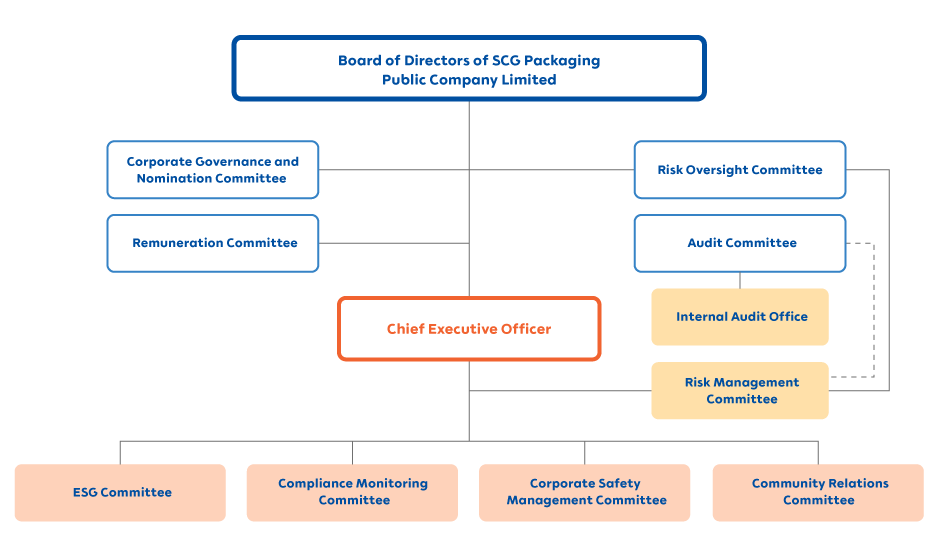
SCGP has established a risk management structure, as depicted in the diagram below:
2.1 Corporate-level Risk Management
Roles and Responsibilities of the Board of Directors
The Board of Directors is responsible for establishing comprehensive risk management policies for entire organization, overseeing effective implementation, and regularly reviewing and assessing the risk management system, including when risk levels change, as detailed in the Charter of the Board of Directors.
Roles and Responsibilities of the Risk Oversight Committee
The Board of Directors assigns the Risk Oversight Committee with outlining appropriate risk management policies for the Company and providing recommendations on risk management policies to the Board of Directors, as well as promoting continuous improvement of risk management systems at all levels throughout the organization.
Roles and Responsibilities of the Audit Committee
The Board of Directors assigns the Audit Committee to review and ensure that the risk management process is efficient and effective, and that regular reports on risk management shall be made to the Audit Committee and the Board of Directors respectively.
Roles and Responsibilities of the Risk Management Committee
The Risk Management Committee consists of the Chief Executive Officer, who serves as Committee The Risk Management Committee consists of the Chief Executive Officer, who serves as the Committee Chairman, Chief Operational Officer of each business unit, Chief Regional Officer, Chief Customer Officer, Chief Operating Officer - Technology Sustainability and Productivity Officer, and Chief Financial Officer. The Risk Management Committee has the following core responsibilities:
- Establish the risk management structure and identify responsible persons.
- Consider and approve the risk management strategy, the risk management framework, and the risk management plan.
- Review SCGP’s risk profile and monitor the performance of risk management throughout the organization.
2.2 Business-level Risk Management and Operational-level Risk Management
Strengthening risk management structures at both business and operational levels to align with company’s strategy. Risk Champions in each business unit, and Risk Coordinators at the operational level play a crucial role in implementing policies, processes, and risk management frameworks at their respective levels, as well as following established procedures. Using the Risk Assessment System (RAS) to identify, assess, monitor risk items, enabling access to monitor risks in a timely manner. Together with the Enterprise Dashboard and Performance Management System (PMS) to track performance to achieve business target and prepare risk management plans as part of the medium-term and annual business planning proposed to the Board of Directors
3. Risk Management Process
SCGP integrates the risk management framework into core operations, including strategic, investment project risk management, and operational risk management. The risk management process consists of the following key steps:
(1) Identify business risks/opportunities from both existing risks and emerging risks to align with the circumstances at each period.
(2) Assess the likelihood and impact of risks and opportunities with the RAS and Risk Map tool to determine the severity level and priority, using a common risk assessment system.
(3) Establish risk management measures, including key risk indicators and key performance indicators as both leading and lagging indicators, to anticipate risk events and control operations to achieve desired targets.
(4) Report risks to the Risk Management Committee and the Risk Oversight Committee, covering immediate risks, intermediate risks, and specific risks related to current situations, such as IT risks, while reporting to the Audit Committee on a quarterly basis.
(5) Regularly review risk management policies by taking into account significant changes to the organization.
To ensure a thorough risk consideration and alignment with the organizational context, the risk assessments must be conducted across the following risk universe categories:
(1) Safety, Health, and Environmental risk (2) Compliance risk (3) Intangible Risk (4) Hazard risk (5) Input risk (6) Process risk (7) Financial risk (8) Business risk
4. Risk Management Culture within the Organization
SCGP recognizes that corporate culture is an essential enabler for the success of risk management. Therefore, an organizational culture that promotes risk management is encouraged through the following activities :
- Assigning top executives to communicate the significance of risk management and serve as role models. This includes establishing practical guidelines for a common risk language, risk appetite, and common risk assessment systems throughout the organization.
- Assigning clear roles and responsibilities of risk owners for each risk item to ensure clarity and accountability in risk management.
- Embedding risk management agendas in key meetings of each subsidiary at the executive level.
- Encouraging experience sharing across departments and subsidiaries to continually communicate the benefits of risk management.
- Systematically developing risk management capabilities by assigning Risk Champions at business level and Risk Coordinators at operational level to attend risk management training annually so that risk management tools can be applied appropriately.
- Incorporating risk management into new hire training and development programs, as well as developing e-Learning courses accessible to all employees.
5. Risk Factors and Risk Management
In 2025, SCGP identified, assessed, and developed risk management plans for significant risks covering strategic, operational, financial, and compliance risks, as well as emerging risks that may impact organizational goals and operations, as well as risks posed to the investment of shareholders as follows:
| Key Risks | Severity | Key Risk Indicators | |
|---|---|---|---|
| Strategic Risk | Volatility in Global Economy, Trade, and Geopolitics | High | Packaging demand growth rate, sales volume and selling prices of packaging products |
| Merger & Partnership (M&P) Integration | Medium | Success level in business integration, operating results of acquired businesses | |
| Low-carbon Economy Transition | Medium | Greenhouse gas emissions, proportion of renewable energy consumption, carbon tax-related costs, proportion of low carbon footprint products | |
| Talent Development for Expansion | Low | Talent retention rate, employee engagement level within the organization | |
| Operational Risk | Health and Safety from Operations, Transportation, and Travel | High | Number of accidents and work-related fatality rate, proportion of employees trained in safety and accident prevention, number of complaints or reports of workplace safety issues |
| Cybersecurity and Data Security | Medium | Cybersecurity threat detection rate, number of cyber-attack incidents, proportion of employees trained in cybersecurity | |
| Cost Management in Supply Chains | Low | Energy and key raw material price index, freight index, labor costs, proportion of domestically sourced raw materials | |
| Human Rights | Low | Number of human rights complaints, number of suppliers assessed for human rights risks | |
| Natural Disasters Disrupting Supply Chain | Low | Water levels of nearby water sources, disruption rate of raw material and product transportation | |
| Financial Risk | Interest Rate | Low | Proportion of floating and fixed interest rate debt, changes in market interest rates, cash flows for debt repayment |
| Exchange Rate | Low | Rate of change in major currency exchange rates, ratio of foreign currency-denominated liabilities, gains or losses from exchange rates | |
| Compliance Risk | Changes in Government Policies, Laws, and International Regulations | Low | Number of expired licenses and intellectual property, number of new laws or regulations affecting business operations |
| Emerging Risk | Global Supply Chain Shift Leading to Increased Regional Competition | Medium | Number of competitors in regional markets, market share, FDI investment value |
| Technological Changes and Artificial Intelligence (AI) Adoption | Medium | Number of cybersecurity incidents caused by AI usage or application, proportion of employees trained in digital and AI, coverage of AI policies and governance frameworks | |
| Risk to the Investments of Securities Holders | Risk from a Major Shareholder Holding More Than 50% of the Shares | Medium | Proportion of directors and executives who are independent from the major shareholder |
| Risk from Investment in Foreign Securities (in the Case Where the Issuer Is Foreign Agency) |
| Key Risks |
Mitigations |
|---|---|
| Volatility in Global Economy, Trade, and Geopolitics |
|
|
Merger & Partnership (M&P) Integration |
|
|
Low-carbon Economy Transition |
|
|
Talent Development for Expansion |
|
| Key Risks |
Mitigations |
|---|---|
| Health and Safety from Operations, Transportation, and Travel |
|
|
Cybersecurity and Data Security |
|
|
Cost Management in Supply Chains |
|
|
Human Rights |
|
|
Natural Disasters Disrupting Supply Chain |
|
| Key Risks |
Mitigations |
|---|---|
| Interest Rate |
|
|
Exchange Rate |
|
| Key Risks |
Mitigations |
|---|---|
| Changes in Government Policies, Laws, and International Regulations |
|
| Key Risks |
Mitigations |
|---|---|
| Global Supply Chain Shift Leading to Increased Regional Competition |
|
|
Technological Changes and Artificial Intelligence (AI) Adoption |
|
| Key Risks |
Mitigations |
|---|---|
| Risk from a Major Shareholder Holding More Than 50% of the Shares |
|